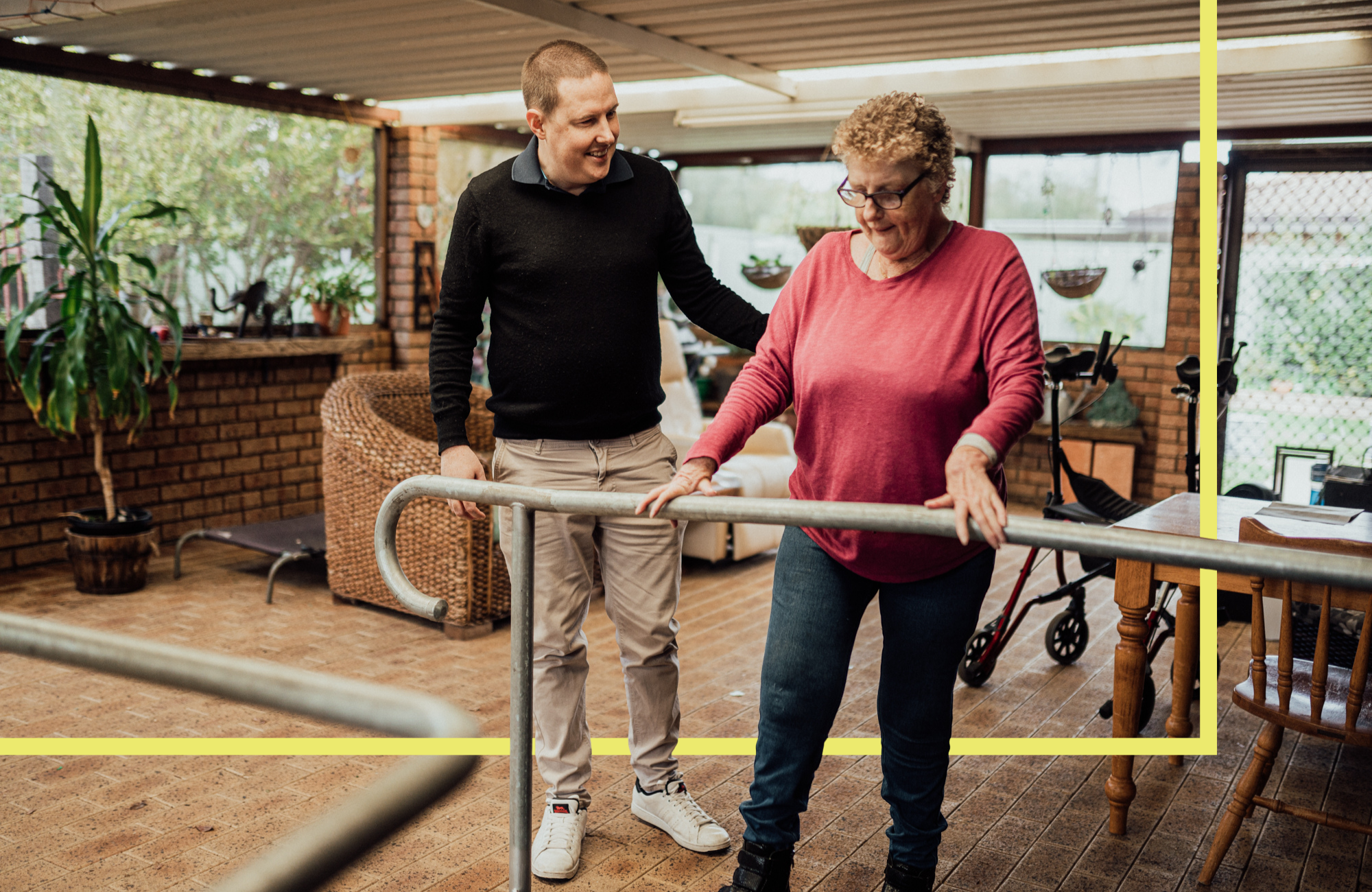

We specialise in providing physiotherapy care to clients in their place of residence, whether that be at their home or aged care facility.
Our physiotherapists are experts in managing a wide range of acute and chronic conditions which affect movement, function, and independence.
We provide a range of physiotherapy services through a patient-centred lens that ensures all clients have the best possible opportunity to achieve their goals.
For Client Management
MAKE A REFERRAL
For Patients
Book appointment
Our physio services include:
- Mobility assessments
- Post-operative rehabilitation
- Cardio-pulmonary rehabilitation
- Chronic disease management
- Incontinence management
- Support at Home Program
- NDIS disability support
- Reablement program
Our at-home physiotherapy services
Mobility assessments
Staying mobile is critical to our overall health and quality of life.
Our team of experienced practitioners are best placed to advise on how to maintain a good level of mobility or improve mobility if it has declined due to age, pain, injury or illness.
Falls risk assessment and prevention
Falls are a very common problem among older people. In fact, one-third of 65 year olds will have at least one fall each year.
We work with our patients to identify their individual risk factors and devise an individualised program to reduce this fall risk.
Prescription of walking aids and equipment
As our mobility declines with age or illness, we may require the use of a walking aid to enable us to stay safe when getting about.
There are many aids available, such as a walking stick (which come in many varieties), a walking frame or a four-wheeled walker to name a few.
These aids can significantly improve your walking quality, duration and your ‘functional capacity’.
They also act as a safety measure to reduce your risk of falling and all the complications associated with a fall.
We understand accepting the use of an aid can be difficult and so our consultations are very much tailored around our patient’s needs and goals.
If an aid is required, we will work with you on choosing the most appropriate aid, helping guide your selection to best suit your lifestyle.


Post-operative rehabilitation
Many operative procedures require physiotherapy to regain full strength, range of joint movement and function following surgery.
Common conditions we treat post-operatively include total hip and knee replacements, post-fracture and general surgical conditions.
Being seen by a physiotherapist promptly is associated with good long-term outcomes.
Strengthening programs following hospital admission
Did you know that bed rest in older adults often results in a significant decline in lower limb strength, power and aerobic capacity.
35% of older people discharged from hospital have a decline in their functional ability compared to when they were admitted.
Our team works with clients to regain what was lost during their hospital rehabilitation so that they can best manage their goals and day-to-day requirements.
Neurological rehab such as stroke, Parkinson’s disease, spinal cord injuries and TBIS
Parkinson’s disease
Parkinson’s disease affects functional activities of daily life by disturbing movement and balance.
An individualised exercise program can be designed by a physiotherapist to maintain muscle length and joint range of movement, improving initiation and co-ordination of movement and maintaining good heart and lung function.
Some other neurological conditions which benefit from physiotherapy management include:
- Guillain-Barre syndrome
- Acquired brain injuries
- Huntington’s disease
- Spinal cord injuries
- Post-polio syndrome
Stroke
Strokes come in varying degrees of severity and consequently have varying effects on people. They can affect movement, vision and/or speech.
Some people have only short term symptoms while others are long-term or permanent.
The aim of physiotherapy is to maximise a person’s ability to perform functional tasks such as walking and upper limb activities.
This is achieved largely through movement retraining and strengthening. Sometimes muscle stretching and splinting may be required.
The earlier rehab is commenced following a stroke, the greater the chance of a good outcome.
Cardio-pulmonary rehabilitation and management
Common cardio-pulmonary conditions we see include:
Chronic obstructive pulmonary disease
This is a common condition characterised by shortness of breath due to reduced flow of air to and from the lungs.
It is not reversible and generally deteriorates over time.
Physiotherapists can help you manage this condition with a specific pulmonary exercise program designed to meet your individual needs.
Bronchiectasis
This is another obstructive lung disease characterised by excessive production of yellow/green sputum.
Physiotherapists can teach you self-management strategies and assist in the clearance of these lung secretions with postural drainage and chest physio.
Arthritis
Arthritic conditions such as osteo-arthritis and rheumatoid arthritis are painful conditions that can affect your movement and ability to perform daily tasks.
Managing this pain is important so that you can maximise your functional ability.
There is good evidence that aerobic exercise within ones tolerance of pain is strongly associated with good outcomes in terms of pain management and function.
A tailored exercise program by a physiotherapist can help you manage your arthritic symptoms that affect you.
Chronic disease management
Long term disease and chronic pain will invariably have an adverse effect on a person’s lifestyle.
Conditions such as diabetes and osteoarthritis, among others, can be managed better with an appropriate program devised by a physiotherapist consisting of appropriate exercise and learning self-management strategies.
Incontinence management
Nearly 4.8 million Australians over the age of 15, including 1 in 3 women, and 1 in 10 men suffer from incontinence.
The proportion of women suffering is higher in those who have had children.
The proportion of men is significantly higher in those who have had prostate or Urinary tract problems.
Most people are unaware that physiotherapists can effectively treat these problems.
Indeed, physiotherapists can treat a large number of a conditions often helping to avoid surgery.
There is now a considerable amount of research to show how effective this form of treatment can be.
Not only can physiotherapists assist with continence problems, but they can also help you avoid these problems before and after surgery and/or pregnancy, through effective and safe exercise programs.
Support at Home Program (Formerly Home Care Packages)
Physiotherapy can be accessed with funds from a government-funded home care plan. We are a preferred provider for number of home care providers who administer plans and are experienced in providing appropriate physiotherapy care within the budget constraints of a care plan.
National Disability Insurance Scheme (NDIS)
We provide allied health services to participants of the National Disability Insurance Scheme. Our team supports people living with disabilities to enhance their mobility, independence, and well-being through tailored care that aligns with their NDIS plan goals.
Start getting physiotherapy support in your home today
We know you value your health, independence, and quality of life, and we’ll work with you to make sure you’re getting the right support to keep doing the things you enjoy. Our focus is on what we can do for you, to maintain your health, movement and mobility – all in the comfort of your own home.
For Client Management
MAKE A REFERRAL
For Patients
Book appointment